membership
A Membership Experience Worthy of the Brand
Destini did not need another membership database. It needed a digital membership experience that felt as considered as the brand itself — from application and approval through to Wallet access, member-only content and the door.
By Lewie Allen ·
Destini is building a private social club around culture, connection and experiences.
That creates a fairly simple expectation:
joining should feel like joining something.
Not filling in a generic form.
Not receiving a PDF.
Not being told to remember another username and password.
And not arriving at an event to find that the digital experience feels completely disconnected from the brand.
That was the real challenge.
Croa's role was not simply to issue a membership card.
It was to connect the different moments around membership into one coherent experience.
The problem with most membership journeys
A lot of membership systems are operationally functional and experientially poor.
The typical journey looks something like:
form → spreadsheet → approval email → account creation → separate event platform → separate check-in system
Every step works.
But the member experiences the joins between them.
Destini wanted something more deliberate.
The brand already had a strong point of view around who it was for and what belonging should feel like. The digital infrastructure needed to support that rather than dilute it.
That meant solving several things at once:
- applications
- approval
- identity
- digital membership credentials
- secure member-only website access
- member-only event registration
- event-day validation
Without turning the whole thing into a maze of logins, apps and disconnected tools.
Joining should feel like joining
The first part of the journey is the application itself.
Destini members apply through a branded registration experience rather than being dropped into a generic membership portal.
The application captures the information Destini needs to make a decision.
Once approved, the member receives their digital membership pass for Apple Wallet or Google Wallet.
That pass becomes the visible expression of membership.
No plastic card.
No separate app download.
No screenshot that slowly becomes stale.
The member carries the credential inside the Wallet already built into their phone.
That sounds like a small change.
It is not.
The moment someone is approved, membership becomes tangible.
Your membership becomes the key
The more interesting part came after issuance.
Destini also wanted members to have access to a private Members Area on its website.
The obvious solution would have been another account system:
create password → verify email → remember login → reset password later
We took a different approach.
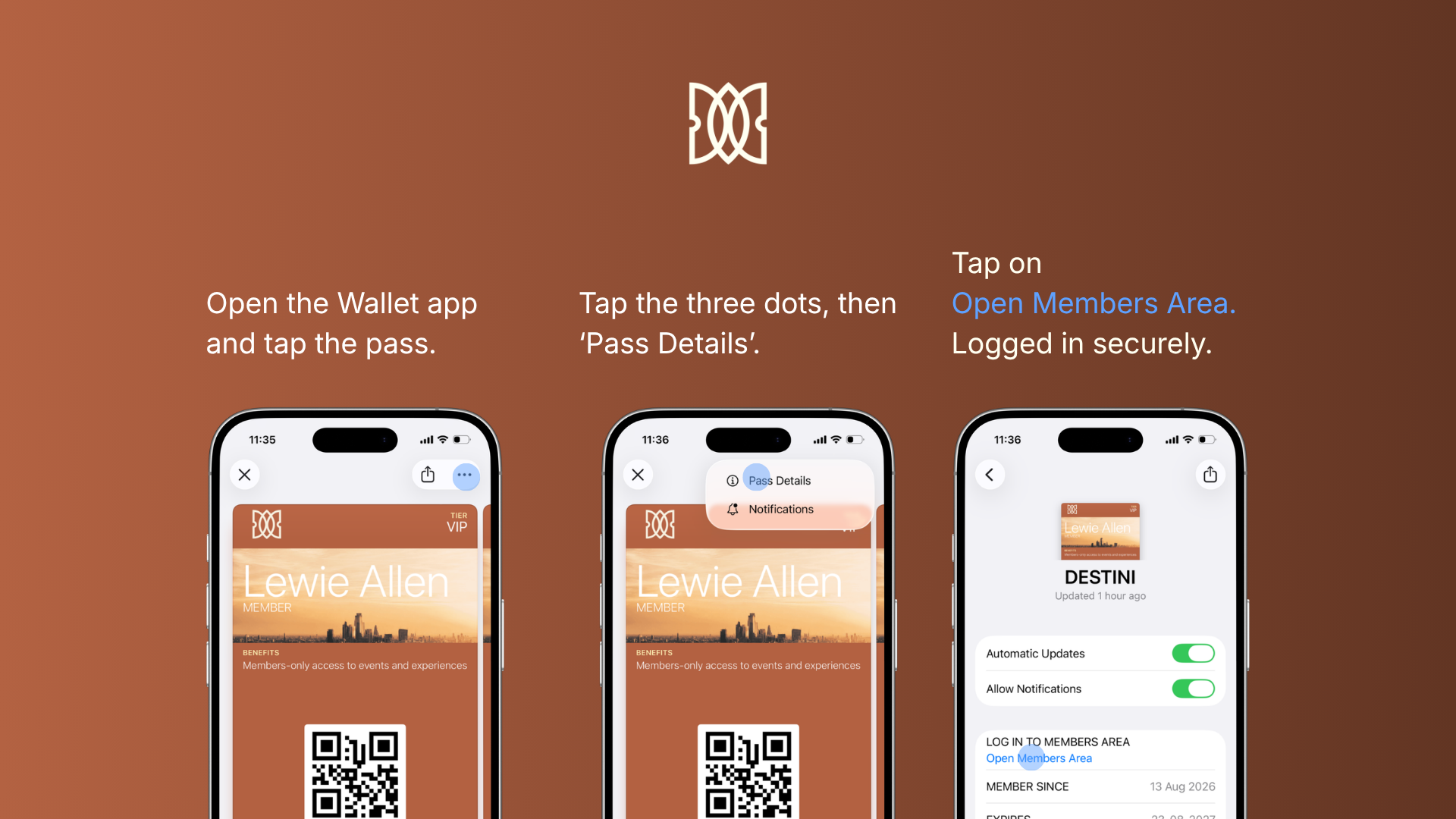
The membership pass itself becomes the starting point for access.
A member can use the Log in to Members Area action from their Wallet pass.
Croa verifies that the membership is still valid, creates a short-lived one-time authentication handoff, and passes the member into Destini's website securely.
Destini then owns the website session.
That distinction matters.
Croa verifies the membership.
Destini controls the destination.
The member does not need to understand any of the infrastructure underneath it.
They just use the thing that already proves they are a member.
No permanent identity token in the URL
This was one of the areas where convenience could easily have created a security problem.
A permanent membership identifier sitting in a reusable URL would have been simple to build.
It would also have been the wrong design.
Instead, the handoff uses a short-lived one-time code.
That means the pass can act as the entry point without exposing a permanent credential that can simply be copied and reused indefinitely.
The result is a much cleaner relationship between membership and access:
valid member → temporary proof → Destini session
Not:
secret URL → hope nobody shares it
Events stay part of the membership experience
For Destini, membership and events are not separate products.
Events are part of the reason the membership exists.
That made it important not to force members into an entirely separate experience every time an event was announced.
Croa allows the membership and event layers to sit alongside one another.
A member can move from being approved, to carrying their membership in Wallet, to accessing private content, to registering for an event and then being validated at the door.
The systems underneath those moments are different.
The member should not feel that.
That is the standard we used.
The door is where bad architecture becomes visible
A lot of digital strategy looks great until people arrive somewhere physically.
Then the queue starts.
Someone has the wrong QR code.
Someone has a membership pass but not an event ticket.
Someone's name is on one list but not another.
Someone is told to step aside while staff change systems.
For a private membership experience, that friction matters.
The person at the door is not thinking about databases or APIs.
They are thinking:
Do these people know who I am?
That makes the check-in layer disproportionately important.
Destini needed to validate both membership and event access without turning the entrance into a technical support desk.
Croa's Terminal provides the operational layer for that interaction.
The ambition is simple:
the technology should disappear quickly enough that the welcome still feels human.
The transaction is not the end of the relationship
This is probably the most important principle underneath the whole implementation.
Traditional event and membership technology often treats the transaction as the destination.
Payment completed.
Ticket issued.
Membership created.
Done.
But for a club like Destini, that is when the relationship starts.
The membership pass can remain on the member's phone.
Details can be updated without reissuing a physical card.
The Members Area can evolve.
Events can become part of the same relationship.
The credential someone received when they joined does not have to die the moment it has been issued.
That creates a much stronger foundation for a membership programme than simply digitising a plastic card.
Designed around the member, not the software
The final journey is deliberately straightforward:
Apply
Get approved
Add membership to Wallet
Access the Members Area
Register for member experiences
Arrive
Be recognised
There is quite a lot happening underneath that sequence.
The member does not need to know.
That is the point.
Good digital membership infrastructure should remove decisions from the member rather than creating new ones.
No unnecessary app.
No plastic credential.
No separate login just because the membership platform wants one.
No obvious boundary between "membership software" and "event software".
Just a connected experience.
What this changed for Destini
The biggest outcome is not that Destini now has a digital membership card.
That would be a fairly small achievement.
It has a membership credential that can participate in the wider member journey.
It can identify the member.
It can unlock access.
It can support event operations.
It can remain useful after the initial application has been approved.
And it gives Destini room to build more around membership without rebuilding the identity layer every time.
For a young membership brand, that flexibility matters.
Because the benefits, content and experiences will evolve.
The infrastructure underneath them needs to be able to evolve too.
The broader lesson
Private members clubs have historically had one obvious symbol of belonging:
the card.
Digitising that card is useful.
But it misses the bigger opportunity.
The better question is:
what should membership actually unlock?
Access.
Content.
Events.
Recognition.
Benefits.
Community.
The credential is simply the connective tissue between those experiences.
That is the direction we have taken with Destini.
Not replacing a physical card with a digital copy.
Building a membership layer that can actually participate in the relationship.